

How to Write an Animated Video Script for eLearning (No Writing Background)
How to write an animated video script with 3 simple steps, plus templates and examples


How to write an animated video script with 3 simple steps, plus templates and examples
It’s hard to hand over animation educational video script writing tasks to others because it contains specialized knowledge that requires your expert to guarantee the video’s accuracy. Moreover, the visual and audio content must be carefully planned so as to deliver the most effective video.
But since you don’t have a scriptwriting background, what should you do?
How to write an animated video script? – Here are some simple steps for you.
When you write your own animation script, you will be surprised by how much time and work you will save later in the production process. Especially if you collaborate with a studio to create animated resources, the script helps you and your animation studio avoid misunderstanding or error in the visual content.
Not everyone is an e-learning professionals, though. Producers can consult you on the most suitable animation type for online courses, or how to produce the best quality in the budget but they are no better instructional designers than you.
Before learning how to write an animated video script, here is a brief description of the animation video production process for you:
Make your online and hybrid course more engaging with simple animation guide, why not?

Before drafting your educational animated video script, it is necessary to prepare the materials. Some writers might call this step, “pre-writing”. In this step, there are 4 main things you have in order to identify to have a successful animated educational video script:
The learning objective:
To build a script that really makes an impact on the audience, it must take the learning objectives into consideration.
For example, if you are developing a video about personal wealth, the objective can be to make learners understand and conduct net worth calculations independently. With this objective, the visual should display the formula, and the audio should be the detailed guide to lead the audience through, step-by-step.
The audience:
Each type of audience requires a unique approach. It would be best if you built an audience persona with at least this main information:
The video message:
There should be one central message for each video to ensure everything you put in the animated educational video script aligns. A tip for this part is to look at the video in comparison with others in the same course and solely as a complete product. Considering these perspectives can help you get your script done without going in the wrong direction.
The animation style:
The audio and the visual for a video go hand in hand, so it’s paramount for you to pay attention to the animation style selection so as to harmonize your audience preferences, your objectives, and your resources. Some of the most common animation styles for education videos are whiteboard, 2D animation, 3D animation…
For a deeper understanding of the animation styles, please see this article:
After you complete the identification step, combine all the information you have collected into an official document called a brief. This brief not only performs as a guide for you to write an educational video script but also serves as a document for later reference from your team or your animation vendor.
The script workspace guides you to understand what types of content can be animated, know how to prioritize the content, and put ít in the script. The above workspace is the most popular one. This style provides you with a clear sight of how the audio and visuals go together simultaneously. It is also an excellent choice for you to estimate the video’s timing without getting things too complicated.
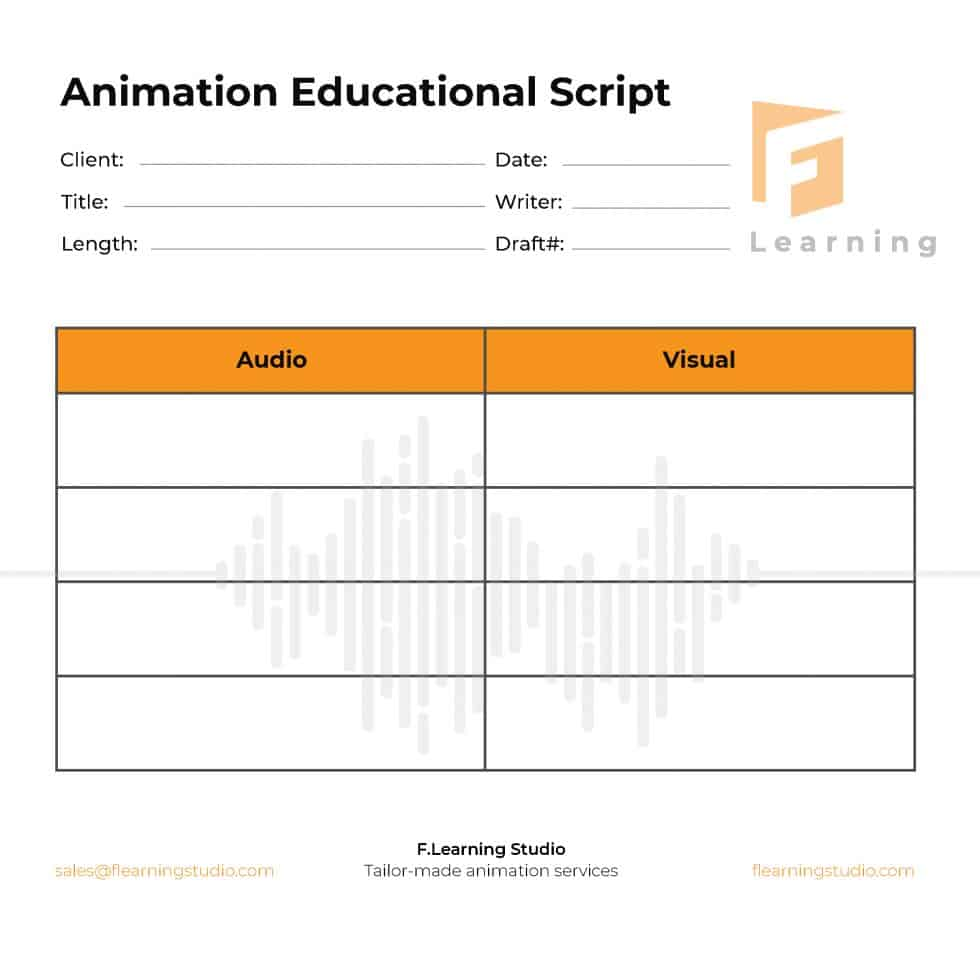
So, it is always the right choice to prepare your workspace before writing an educational video script.
Recommend reading:
Like any writer, before writing a long and detailed educational animated video script, you should plan out your outline. Some questions you need to consider are listed below:
Outline your content just like an article and have someone review it first. After you have your final outline, continue to develop the detailed script.
If you are not sure about the length of the clip, you could use this basic word count tip:
Educational content is usually seen as “dry” because of its academics or hard to absorb. Therefore, it is a good idea to create a storyline for your content. There are two types of stories: a story with a character and without a character.
While constructing your story, it is recommended to add humor elements and personalization to the speech/voiceover to make it more “human” and easy to watch.
For the reviewing part, you can do the review yourself or with a team. It is better to have a clear criteria checklist to ensure you don’t miss anything. Here are our suggestions for your review:
The above questions are only the first-level suggestions for your review session. It can be developed into multiple lower-level questions. Remember to note down your own evaluation or your teammates’ comments. This note will be the primary material for your revising step. Revise it and put it into the feedback loop again (2-3 times tentatively) until you find the final one.
After your team must have already been satisfied with the script, invite some of the potential audience to read your script. Take their comments and adjust accordingly. They may have fresh viewpoints about the video and can give you very sincere ideas. Repeat the “Review and Revise” step 1-2 more times (over two times can be unnecessary).
Once the script is finalized, the next step is production. The scriptwriter should follow through with the production process with the animator. At first, the writer should guide and explain the script to the production team. Later he/she should follow through and monitor the production team to ensure the audio and the visual match.
Recommend reading:
To get a better demonstration, here are three examples of educational video scripts:
If you have an eLearning background, writing an animated educational video script is easier than you think. All you need are the script-writing steps mentioned above and the basic knowledge of animation. Stick to the structure and logic but keep the creativity going to deliver an effective educational video.
Don’t have time to follow all the steps? Why don’t you contact F.Learning? We offer educational script-writing services, and we also have the animation knowledge that will help in your online courses.
Read further:

F. Learning Studio's Author
Sean Bui, the founder and creative director of F.Learning Studio, is a respected leader in the e-learning and multimedia production industry. With over 10 years of experience, he has dedicated his career to helping organizations create engaging and impactful learning experiences. Under his leadership, F.Learning Studio has grown into a trusted partner for organizations in the education, healthcare, and corporate training sectors, producing over 2,000 minutes of educational animation.
Whether you’re training a team or explaining a message — we’ll help you do it clearly.
Clarity changes everything
Whether you’re training a team or explaining a message — we’ll help you do it clearly.