

7 Key Things about Cyber Security Training for Small Business
Effective cyber security training for small businesses is a must. See how F.Learning Studio’s animated videos make learning easy, engaging, and impactful.
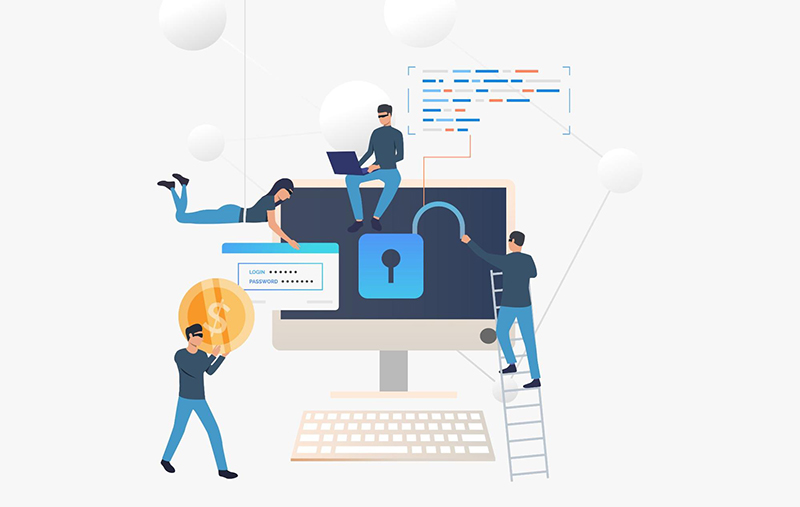

Effective cyber security training for small businesses is a must. See how F.Learning Studio’s animated videos make learning easy, engaging, and impactful.
Cyber security training for small businesses is often overlooked, as many believe only large corporations need to worry about cyber threats. But this view is risky. In reality, small businesses are prime targets for cybercriminals because they often have limited security measures. That’s why implementing strong cybersecurity training is essential.
A solid training program helps small business teams recognize threats early and respond swiftly, protecting sensitive data, customer trust, and the company’s future.
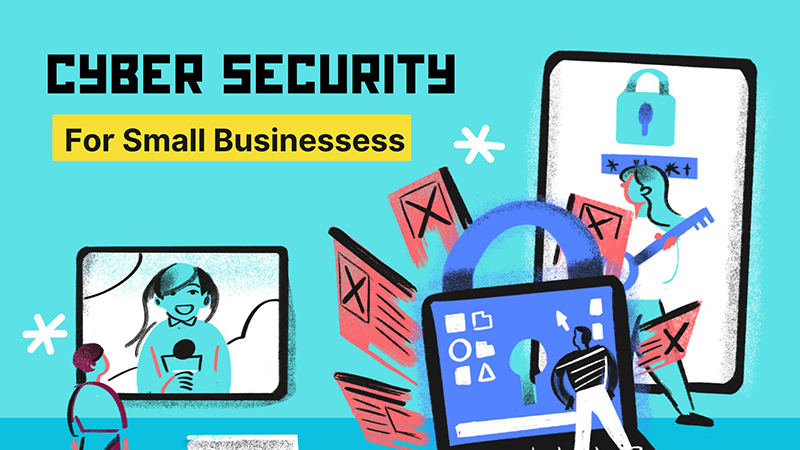
Security used to be simple – just remember a strong password, and you were safe. But now, as cyber threats keep changing, things are more complicated. In this section, let’s look at 4 benefits of security training for small businesses.
Small businesses often deal with sensitive stuff like customer information, financial records, and employee details. Cyber security training should be included to keep this information safe from hackers to show your team how to spot and avoid threats.
When employees know how to handle data securely, they help prevent data leaks, which can save your business from a lot of trouble and maintain customer trust.
Your employees are often the first line of defense against cyber threats, and even one mistake (like clicking a suspicious link) can lead to big issues. With regular training, employees learn to recognize phishing emails, malware, and scams.
This makes them proactive in spotting threats and reporting them. Keeping your team informed about the latest scams helps create a safer environment for everyone.
When a cyber-attack occurs, the costs of recovering from a breach, including legal fees, regulatory fines, and reputational damage can take a toll on your business.
Thus, investing in cybersecurity awareness training for small businesses is a low-cost way to prevent these problems from happening in the first place. It’s a proactive way to save money by avoiding costly security incidents and reducing the need for emergency fixes.
Many countries have strict data privacy laws, such as GDPR and CCPA, that require businesses to protect sensitive information. Certain industries, like healthcare and finance, also have specific cybersecurity regulations that must be adhered to.
Not following these regulations can result in hefty fines, and to avoid this, cyber security training for small businesses is a necessity that can help ensure compliance with specific regulations.
There is a wide range of cyber security training topics, categorized based on the focus, learning objectives, and target audience. Here are some popular types of cyber security training to include in your training program:
Online courses offer flexibility and are often self-paced, making them ideal for busy professionals. They cover a wide range of topics, from basic cyber security concepts to advanced technical skills. Below are the 2 courses that will provide your employees with essential cybersecurity skills.
These sessions provide hands-on experience and direct interaction with instructors, enhancing understanding. For example, SANS Institute Training Events offer live sessions on various cybersecurity topics, while Local Cybersecurity Workshops at community colleges and organizations provide small businesses with tailored training options.
Webinars provide a convenient way to learn about cybersecurity topics in real-time, making it easy for businesses to stay updated without disrupting daily operations. These sessions cover specific issues, such as emerging threats or industry best practices, allowing participants to ask questions and engage directly with experts.
If you want to give your team insight into practical security strategies, Infosec Institute Webinars, which focus on the latest cybersecurity trends and best practices, are a good choice. Similarly, the NIST Small Business Cybersecurity Corner offers webinars and resources designed specifically for small businesses with guidance from industry leaders.

This type of cyber security training for small businesses tests employees’ ability to recognize and respond to phishing attempts, enhancing their vigilance. In these exercises, employees receive fake emails that look like real phishing attempts.
The goal is to see if they can identify signs of a scam, such as suspicious links or urgent requests for personal information. After the exercise, participants receive feedback on their responses, helping them learn what to watch for in actual phishing emails.
On-site cyber security training for businesses brings experts directly to a small business, providing a personalized learning experience. This approach allows the training to be customized to the specific systems, tools, and challenges that the business faces.
Employees can ask questions and get immediate feedback on real-world issues, which strengthens their understanding. Additionally, on-site training minimizes the disruption of sending employees offsite and helps team members learn together.
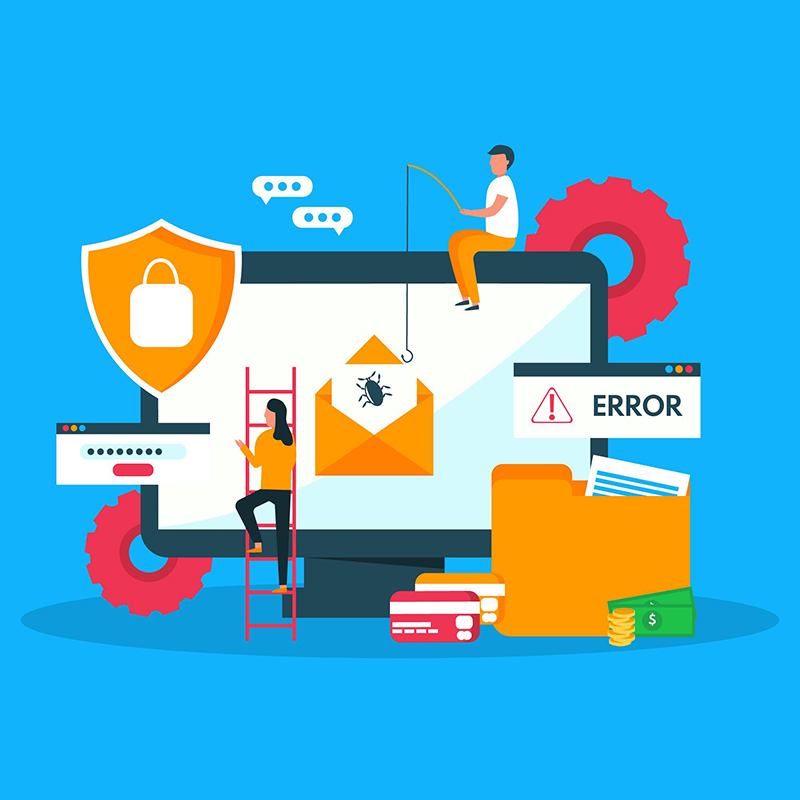
When it comes to cybersecurity training for small businesses, choosing the right format can make a big difference in effectiveness. Here are some recommendations for each type to ensure optimal results.
Workshops tailored to your team’s needs can make a big impact, but it’s essential to choose topics that address specific risks your business faces. Beforehand, assess your team’s cybersecurity knowledge to identify key areas for focus, like phishing or data protection.
Look for trainers who can offer practical scenarios that resonate with real-life situations employees might encounter. Also, consider scheduling workshops periodically to keep information fresh and updated as new threats emerge.

Webinars bring valuable expertise to your team without travel, but they work best with some preparation. To avoid overwhelming participants, choose speakers who can explain complex ideas in simple terms.
Plan for a Q&A session where employees can ask specific questions, making the webinar interactive. Follow up with a brief discussion or summary to reinforce the main takeaways. Recording the webinar is also helpful, so employees can revisit it later or new hires can benefit from the insights.

Quizzes are great for reinforcing cybersecurity knowledge, but keep them varied and engaging. To motivate employees, you can add a bit of friendly competition or small rewards for high scores. Analyzing quiz results can also highlight areas where further training might be needed, so you can make the most of your program.
If you want to take it to a high level, gamify the process with interactive designs that keep your employees engaged and motivated.
Don’t know what to do? F. Learning is here to help you with cool and effective interactive exercises that enhance understanding and boost retention:
Transform Cybersecurity Training into Engaging Experiences with F.Learning Studio Today!
Quizzes and assessments enhance cybersecurity knowledge through engaging, interactive scenarios
An on-demand cybersecurity helpdesk provides employees with real-time support for security questions. This setup can be managed by an internal team or outsourced to a trusted provider who understands the company’s systems. The helpdesk is especially helpful for guiding employees through suspicious scenarios, such as unexpected email requests or login alerts.
Certification programs provide employees with in-depth knowledge and credentials in cybersecurity. The business should consider offering sponsorship for certifications that lead to recognized credentials like CompTIA Security+ or CISSP for more advanced needs.
These programs can boost your business’s security and enhance employee retention. It also signals to clients and partners that your company takes cybersecurity seriously.
The following steps outline key practices to help you create a strong cybersecurity program. These steps ensure that training is relevant, ongoing, and targeted to address the specific risks your business faces.
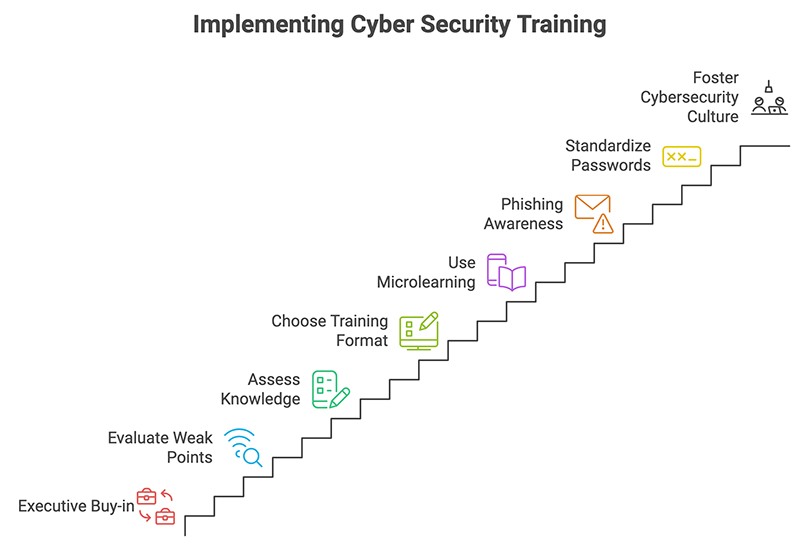
| Step | Best practice |
| 1. Get executive buy-in | Show leadership how cybersecurity training directly protects company data and customer trust. Use examples of recent breaches and quantify potential savings from training. |
| 2. Evaluate cybersecurity weak points | Assess your company’s vulnerabilities, like risks in payment processing, email phishing, or data storage. Target training to address these specific weak points first. |
| 3. Assess current employee knowledge | Run a cybersecurity knowledge check to find gaps. This way, training can be customized to address areas like secure browsing, email safety, or password management. |
| 4. Choose the right training format | Select the training format that best fits your team, such as online courses, webinars, or in-person workshops. |
| 5. Use microlearning for key concepts | Deliver bite-sized cybersecurity tips, like recognizing phishing emails or safe internet practices. |
| 6. Emphasize phishing scam awareness | Regularly update employees on spotting phishing attacks, as these are the most common entry point for cyber threats. Provide real examples to enhance vigilance. |
| 7. Standardize password policies | Create a clear password policy with requirements for length, complexity, and frequency of changes. Implement automatic prompts and consider two-factor authentication for extra security. |
| 8. Incorporate personal security examples | Use personal stories or common cybersecurity incidents (e.g., identity theft) to illustrate the risks. Real experiences make employees more vigilant about their actions. |
| 9. Run real-time cyberattack simulations | Conduct live cybersecurity drills like simulated phishing or ransomware attacks. These “live-fire” tests help to measure readiness and identify response improvements. |
| 10. Integrate training early and frequently | Make cybersecurity training a core part of onboarding and follow up with quarterly refreshers. This keeps employees aware of new threats and best practices. |
| 11. Foster a team-based cybersecurity culture | Make cybersecurity everyone’s responsibility with continuous updates and collaborative training. Regularly adapt training to new threats and changing technology. |
Transform Cybersecurity Training into Engaging Experiences with F.Learning Studio Today!
Starting a cybersecurity training program for your small business might seem daunting, but don’t worry! To support you and your team get started and ready to implement cyber security training, here are some resources that provide valuable insights.
Various government agencies provide valuable resources for cybersecurity training. The U.S. Small Business Administration (SBA) offers guidance on cybersecurity best practices tailored for small businesses. Similarly, the Cybersecurity and Infrastructure Security Agency (CISA) provides free resources, including training materials and toolkits designed to help organizations improve their cybersecurity posture.
There are numerous online platforms that offer comprehensive cybersecurity training courses. Websites like StationX provide access to over 1,000 classes covering topics from basic security principles to advanced techniques. Other platforms, such as Coursera and Udemy, offer courses created by industry experts with certifications.
Engaging with cybersecurity communities can be beneficial for small businesses. Joining groups on platforms like LinkedIn or Facebook allows professionals to share experiences and resources. Local meetups and conferences, such as BSides or DEF CON, provide networking opportunities with industry experts and peers, which foster collaboration and knowledge exchange in a supportive environment.
Measuring the effectiveness of cybersecurity awareness training is essential for small businesses to understand its impact on reducing risks and improving security. By doing so, businesses can identify their training efforts’ effectiveness, justify costs, and fine-tune programs for better results.
You should start by identifying direct costs, like training expenses, employee time, and any software or tools used. Then, consider benefits such as reduced security incidents, lower downtime, and improved customer trust, which directly contribute to ROI.
The basic formula for calculating ROI is:
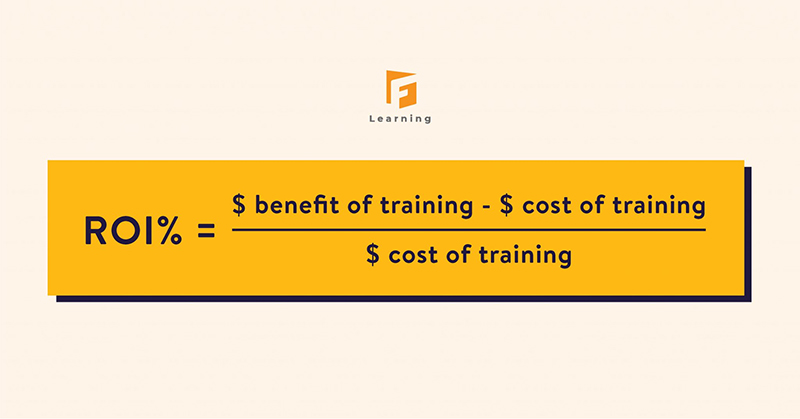
This formula compares the financial benefits gained from improved security practices against the costs incurred from implementing the training program.
The ALE formula helps establish a baseline for understanding potential losses without effective training. You can estimate the cost of potential cyber incidents before and after training with this formula:
ARO x SLE = ALE
For example, if an employee falls for a phishing scam, it could cost the business around $5,000 due to lost revenue, data recovery costs, and potential fines.
The ARO is the estimated frequency of these attacks succeeding over a year. If, based on past incidents or industry data, the business expects a successful phishing attack once every two years, the ARO would be 0.5.
Now, multiply the SLE by the ARO to get the ALE.
ALE = 5,000 × 0.5 = 2,500$
The improvement in cyber security awareness can be observed through practical behavior changes, like stronger password practices, increased reporting of suspicious emails, and adherence to company security policies. These changes reflect how well your employees are applying what they learned.
Track how quickly and effectively employees respond to security incidents. Faster, more efficient responses suggest that training is helping them handle threats better.
Beyond direct financial returns, you should consider non-monetary benefits like enhanced employee confidence, better client trust, and strengthened company reputation. While harder to quantify, these factors add significant value to your business in the long run.
With a solid cybersecurity training program in place, the next step for small businesses is to build a strong cybersecurity foundation that supports and reinforces the skills employees have gained.
While training equips employees with essential skills and awareness, maintaining a secure business environment requires continuous practices and strategies below.
Building a cybersecurity culture means creating an environment where everyone understands and values security. Here’s how to get there:
Regular assessments help you spot weaknesses and make sure security measures are working. Here’s the rundown:
Keeping your team engaged with cybersecurity training can feel like a tall order. You may need the help of F. Learning Studio – an expert in turning complex topics into clear, engaging content that sticks.
Cybersecurity training doesn’t have to be dry or overwhelming. At F.Learning, we use engaging animations to make complex topics clear and memorable. Animation adds a dynamic element that grabs attention and keeps learners invested, making the training process more effective and enjoyable.
With F.Learning’s animated approach, your team won’t just watch—they’ll truly understand and remember the critical steps to protect your business.
We understand that every business faces its own set of cybersecurity challenges. F.Learning specializes in creating custom training solutions that align with your specific goals. Whether it’s animated videos or interactive quizzes and assessments, we’ll work closely with you to address your unique needs, making your cybersecurity training relevant, practical, and impactful.
High-quality cybersecurity training doesn’t need to come with a high price tag. Our efficient workflows, flexible pricing options, and experience in creating impactful educational content make our services surprisingly affordable without compromising quality.
By partnering with F.Learning, you get the best of both worlds: exceptional, customized training that prepares your team to handle cyber threats, all while keeping costs manageable for your business.
Transform Cybersecurity Training into Engaging Experiences with F.Learning Studio Today!
No matter the size of your business or the industry you’re in, having a strong, adaptable cybersecurity strategy is essential. And the key to keeping it that way? Effective training. With our experience and expertise, we can make cyber security training for small businesses a breeze! Contact F.Learning Studio now to get started and create training that’s easy to understand and hard to forget.
1. How do I set up cyber security for my small business?
Start with basics like antivirus software, strong passwords, and firewalls. Secure your Wi-Fi, back up data regularly, and train employees on recognizing phishing attempts and using safe internet practices. If possible, consult a cybersecurity professional for extra guidance.
2. Do small businesses need cyber security?
Yes! Small businesses are often targeted because they have fewer defenses. Cybersecurity protects your data, finances, and reputation, and helps with regulatory compliance.
3. What is the best cyber security software for small businesses?
Popular options include:
4. How do I train my employees for cyber security?
Offer regular training sessions, run phishing simulations, and use quizzes to reinforce learning. Customized workshops and an on-demand helpdesk can provide extra support and address specific needs.

F. Learning Studio's Author
Sean Bui, the founder and creative director of F.Learning Studio, is a respected leader in the e-learning and multimedia production industry. With over 10 years of experience, he has dedicated his career to helping organizations create engaging and impactful learning experiences. Under his leadership, F.Learning Studio has grown into a trusted partner for organizations in the education, healthcare, and corporate training sectors, producing over 2,000 minutes of educational animation.
Whether you’re training a team or explaining a message — we’ll help you do it clearly.
Clarity changes everything
Whether you’re training a team or explaining a message — we’ll help you do it clearly.