

Calculating Training ROI: Everything You Need to Know
Let’s figure out 5 typical approaches to calculate training ROI (Return on Investment) so that you can complete an all-inclusive L&D strategy.


Let’s figure out 5 typical approaches to calculate training ROI (Return on Investment) so that you can complete an all-inclusive L&D strategy.
Employee training is also a significant investment. That’s why it’s important to know whether your training budget is spent effectively or not. Particularly, you need to calculate training ROI (return on investment), both revenue-based and influence-based, to justify every dollar spent. Are you still unfamiliar with this measurement? Do not worry! Keep reading the article for a start-to-end guide on training ROI and how to calculate it.
According to a survey, nearly 45% of respondents say they don’t measure training ROI due to the lack of data. So where and how you can get this data?
Your L&D team is not the only one that sets training goals. Meet with other departments to discuss who is the audience and why they need to join the training. Consequently, you can figure out and agree on what are the training goals.
Note that you should align training with strategic business goals and set the goals as specific as possible. For instance, the Sales team can increase revenue by 25% over the next year after joining the sales training programs.
Besides, you can also divide all training goals into:

If you’re struggling to choose the right metrics, here are our suggestions:
You can track selected metrics through any existing system in your organization like CRM, HR system, customer service software, etc. Again, involve leaders from other departments so that you can access their tracking resources.
Remember to collect information both now and in the past. All data of non-trained and training employees, from pre-training to post-training implementation are required. You should also follow up with leaders regularly after the training to get those figures always up-to-date.
Wondering if you miss anything in your preparation to digitize your training? This is just what you need.
So now you know exactly the training goals and have the data of its metrics. It’s time to figure out some formula to measure training and development ROI.
In this article, F. Learning Studio recommends five typical ways to calculate training ROI
The most basic training ROI calculator is the ratio of total training cost relative to the total training benefits. This approach especially works best with monetary measurable benefits such as manufacturing or sales.
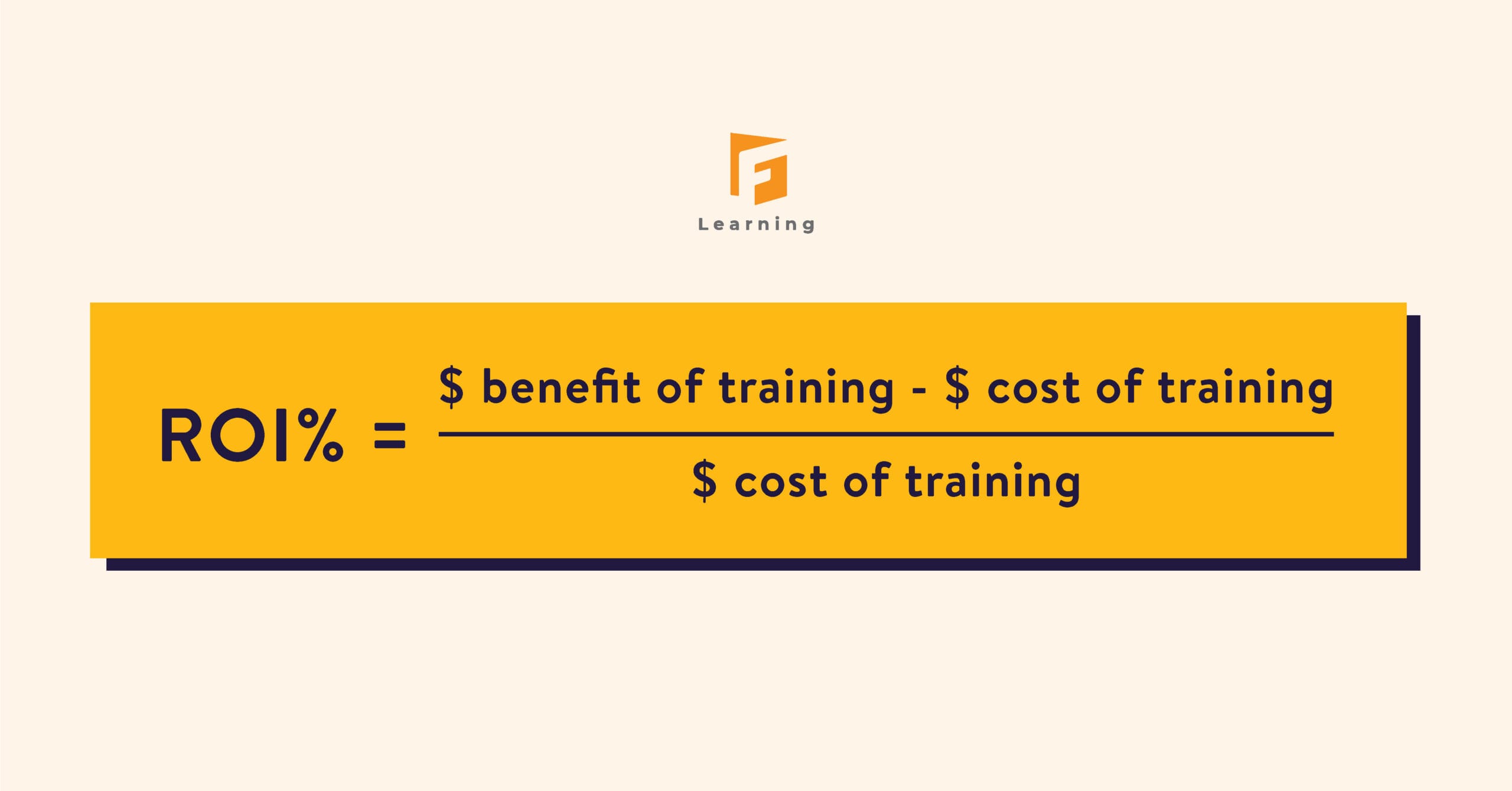
To give you an idea, imagine you spend $30,000 on 100-day training for 30 call center agents.
After the training, one staff can handle 25 calls per hour, compared to 20 calls per hour before the training. This means productivity increases by 25 percent.
If each call costs $1 on average, then the productivity improvement is worth $5 each hour. Relatively, it is worth $40 per staff over an 8-hour working day.
So the total net benefits for thirty employees is $1,200 per day and $120,000 over the training period. Using the formula above, you can calculate the training ROI as
ROI%=($120,000-$30,000)/$30,000 x 100 = 300%
Think about managerial positions with unstructured work, it’s difficult to get measurable benefits for training ROI calculator. So the alternative approach is to turn supervisor assessments into a monetary value.
Particularly, their manager will make judgments of trainees’ performance through on-the-job assessments and observations. For example, the assessment might include some areas like task completion, task complexity, teamwork, and customer service. It will take place before and after the training so that you can highlight differences coming from the training.
Following the example, the manager will make judgments for a group of 3 team leaders using average percentages:
The average improvement will be 6.25%. The annual salary of a team leader is $70,000 on average. So, the monetary benefits are $4,375 per year for each employee and $13,125 per year for those three.
As the total cost is $7,500, apply the formula above to get the training and development ROI.
ROI%=($13,125-$7,500)/$7,500 x 100 = 75%

To calculate training ROI, you can create a study of business impacts that are brought about by the training programs. They could be sales, market share, customer feedback, etc.
Below is the 3-step process to create a business impact study
Evaluation planning
In this stage, define the indicators and inputs that you need for evaluating the training objectives. For example, the number of classes and participants, delivery time, or total costs.
Data collection
Collect all the required data throughout the training implementation. You can survey to ask employees to rate their learning experience, reaction, satisfaction, and self-evaluate. You can also use supervisor assessments additionally as above.
Along with this, collect all business financial data of new customers, sales, market share, churn rates, or any relevant data.
Data analysis & report
Similarly, you convert the data to monetary numbers to calculate the ROI using the typical formula.

Back in the 1950s, Dr. Don Kirkpatrick first introduced his four-level training evaluation model. Basically, the model guides L&D executives to evaluate training effectiveness by four levels: Reaction – Learning – Behavior – Results.
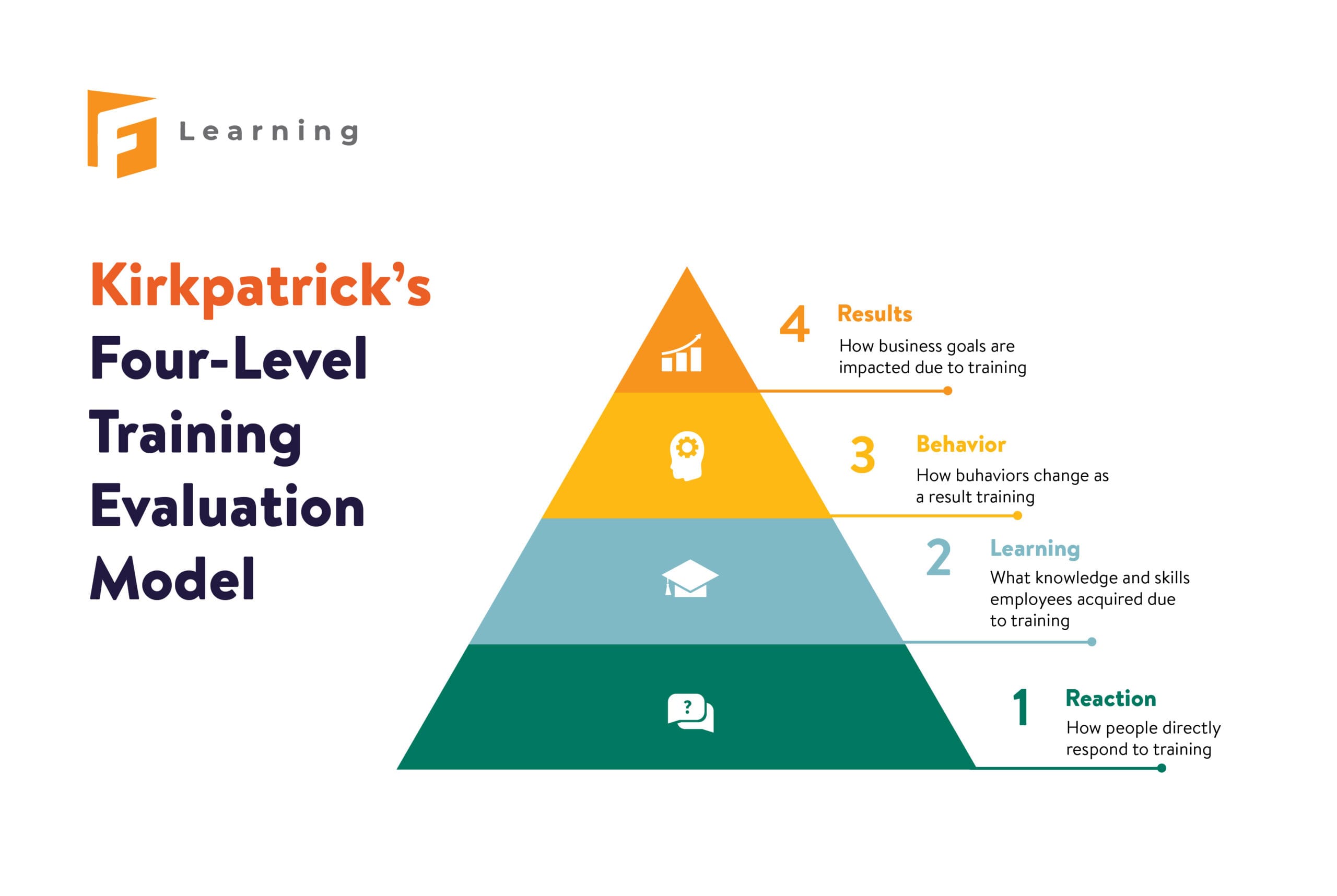
Learn more about the Kirkpatrick Model at
Kirkpatrick does not mention measuring training ROI in his model. That’s why Jack Phillips expanded this basic work into a 10-step training evaluation called the Phillips ROI Methodology. With the addition of training ROI, the Phillips ROI Methodology covers six types of data, including:

Let’s take a manufacturer’s employee training for example to see how to measure ROI for training following this methodology.
The production supervisor requests training for ten staff with the goal of increasing their productivity. The total cost for this program is about $10,000.
According to the result in level 3, the average productivity of each employee shows an improvement of 16,6%.
An hourly rate of staff is $12 with an 8-hour working shift. So, the productivity increases by $1,593.6 per employee in 100 days. The training results in $15,936 for ten staff who join the training.
Use the standard ROI formula above to get your final answer:
ROI% = ($15,936 – $10,000)/$10,000 X 100 = 59.36%.
This is probably the easiest approach of how to measure ROI for training. Using an existing Learning management system (LMS) can help you to automate a lot of work for the measurement, including:

Recommended reading:
There is no exact answer for all. The most suitable approach for training ROI measurement will depend on each particular course, its time frame, and its budget. In particular,
The training ROI calculation is among the most helpful practices of organizations to track the training effectiveness within business goals. Hopefully, this article can give you more confidence in maintaining and leveraging your learning and development strategy.
Read more:

F. Learning Studio's Author
Sean Bui, the founder and creative director of F.Learning Studio, is a respected leader in the e-learning and multimedia production industry. With over 10 years of experience, he has dedicated his career to helping organizations create engaging and impactful learning experiences. Under his leadership, F.Learning Studio has grown into a trusted partner for organizations in the education, healthcare, and corporate training sectors, producing over 2,000 minutes of educational animation.
Whether you’re training a team or explaining a message — we’ll help you do it clearly.
Clarity changes everything
Whether you’re training a team or explaining a message — we’ll help you do it clearly.